First Monday of April, 1625
D'Artagnan Leaves Home
Young d'Artagnan departs from his family home in Gascony for Paris, armed with little more than his father's letter of introduction to Monsieur de Treville, captain of the King's Musketeers, a yellow horse, and fifteen crowns. His father's parting advice emphasizes courage, loyalty to the king and cardinal, and the importance of seeking adventure. His mother gives him a miraculous balsam for wounds. This departure marks the beginning of d'Artagnan's quest for fortune and glory.
First Monday of April, 1625
The Meung Encounter
On his journey, d'Artagnan stops at the Jolly Miller inn in Meung, where he is mocked by a mysterious gentleman for his horse. Enraged, d'Artagnan challenges the stranger, but is quickly overpowered by the man's servants and knocked unconscious. The stranger, who is revealed to be the Comte de Rochefort, an agent of Cardinal Richelieu, steals d'Artagnan's letter of introduction. This event establishes d'Artagnan's first major enemy and sets the stage for his future conflicts.
Early in the story
Arrival in Paris
After recovering from his injuries, d'Artagnan arrives in Paris. He sells his yellow horse and finds a modest lodging in the Rue des Fossoyeurs, near the Luxembourg Palace. He then goes to the Quai de Feraille to have a new blade fitted to his sword before heading to the Louvre to find the residence of Monsieur de Treville. His first day in the capital is filled with the practicalities of establishing himself in a new city.
Early in the story
Audience with Monsieur de Treville
D'Artagnan presents himself at the Hotel de Treville, where he witnesses the chaotic and boisterous atmosphere of the Musketeers. He observes the three inseparables, Athos, Porthos, and Aramis, for the first time. When he finally gains an audience with Treville, he explains that his letter of introduction was stolen. Treville, intrigued by d'Artagnan's story and recognizing the description of the thief as Rochefort, offers him a place in the Royal Academy to train, rather than an immediate commission as a Musketeer.
Early in the story
First Conflicts with the Musketeers
Leaving Treville's office, d'Artagnan accidentally offends each of the three Musketeers in turn. He bumps into Athos's wounded shoulder, becomes entangled in Porthos's cloak, and clumsily returns a handkerchief belonging to Aramis's lady friend. These incidents lead to three separate duels being arranged for later that day. D'Artagnan, though outmatched, shows his courage by accepting all three challenges.
Early in the story
The Duel and the Cardinal's Guards
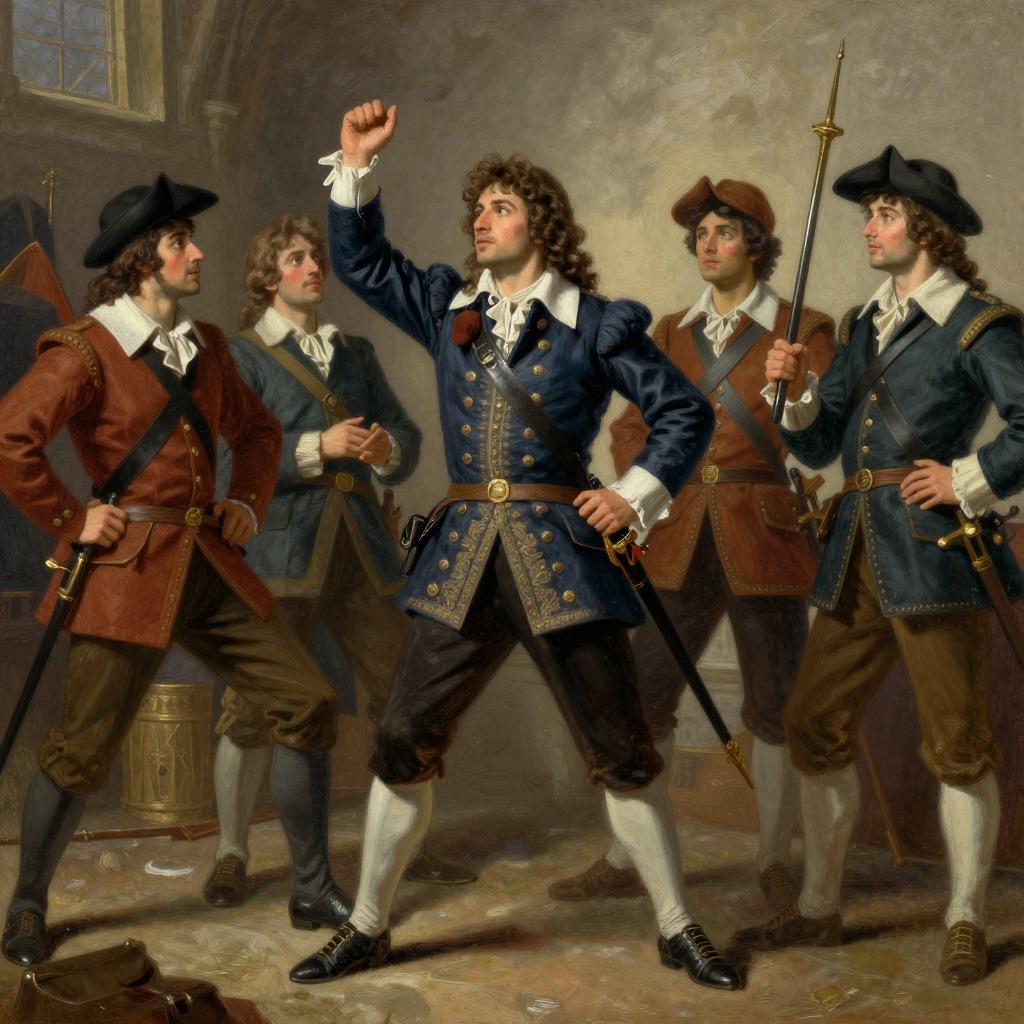
D'Artagnan meets Athos at the designated dueling ground near the Carmes-Deschaux. As they prepare to fight, Porthos and Aramis arrive as Athos's seconds. Before the duels can begin, they are interrupted by a patrol of Cardinal Richelieu's Guards led by Jussac, who attempt to arrest them for illegal dueling. The four friends, now united against a common enemy, decide to fight the Guards instead of each other.
Early in the story
Victory Over the Cardinal's Guards
In the ensuing battle, d'Artagnan and the three Musketeers fight valiantly against the five Cardinal's Guards. D'Artagnan proves his mettle by wounding Jussac, while Athos, Porthos, and Aramis defeat their own opponents. The victory is a resounding success, and the four men, having fought side-by-side, forge an unbreakable bond of friendship. They return to Treville's hotel in triumph, with d'Artagnan having earned his place among them.
Early in the story
The King's Favor
King Louis XIII, initially angered by the brawl, is won over by Treville's account of the fight and the bravery of d'Artagnan. The king rewards d'Artagnan with forty pistoles and arranges for him to be placed in the company of the King's Guards under Monsieur Dessessart, as a step towards becoming a Musketeer. The cardinal is furious at the defeat of his men, but the king is pleased, marking the beginning of d'Artagnan's royal favor.
Early in the story
The Four Friends' Life in Paris
D'Artagnan and the three Musketeers become inseparable companions. They share meals, adventures, and their meager finances. D'Artagnan, though not yet a Musketeer, serves alongside his friends on guard duty. The four lackeys—Planchet, Grimaud, Mousqueton, and Bazin—are introduced, each with their own distinct personality. Their life is a mix of camaraderie, dueling, and scraping by on limited funds.
Early in the story
The Abduction of Madame Bonacieux
Monsieur Bonacieux, d'Artagnan's landlord, seeks his help after his wife, Constance, is abducted. D'Artagnan learns that Constance is the queen's seamstress and that her abduction is linked to a court intrigue involving the queen, the Duke of Buckingham, and Cardinal Richelieu. D'Artagnan, motivated by a growing affection for Constance, vows to rescue her, drawing himself deeper into the dangerous political games of the court.
Early in the story
The Mousetrap
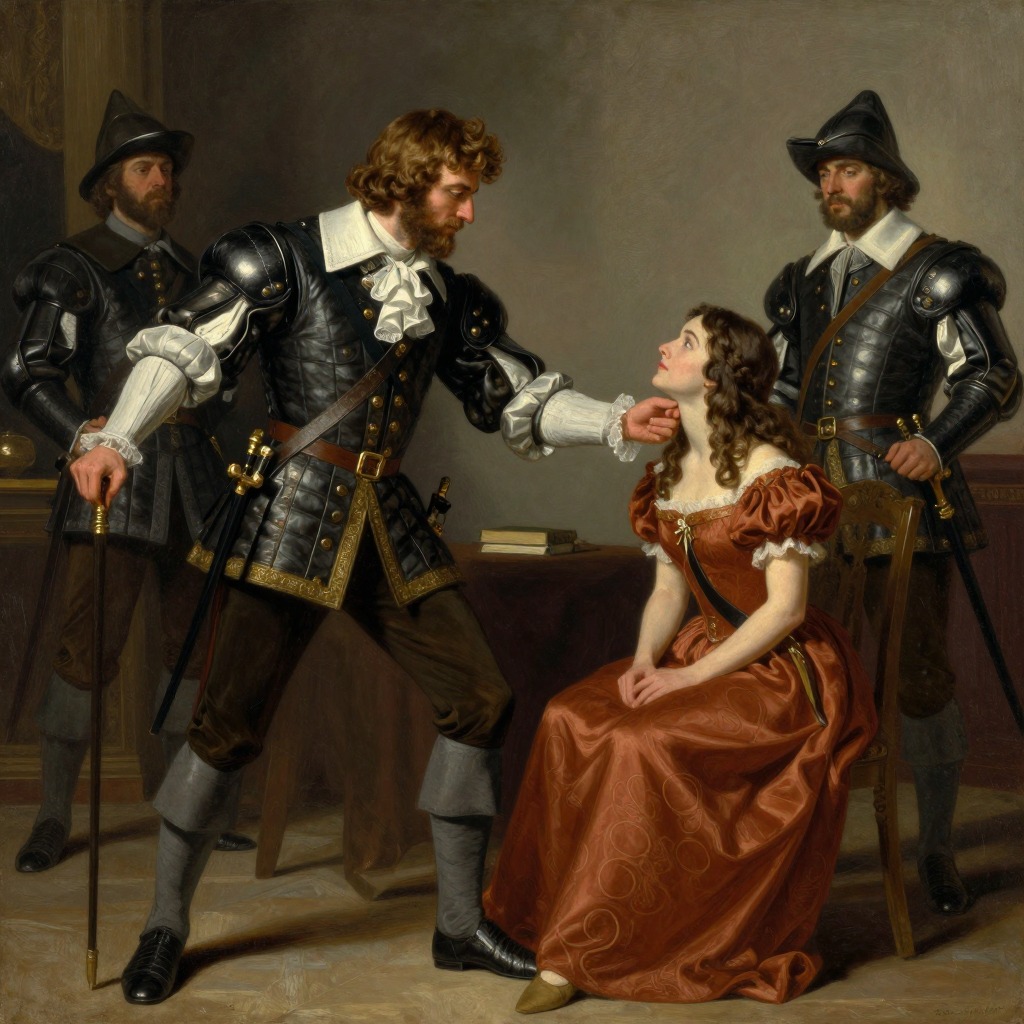
The cardinal's agents set a trap in Bonacieux's house, hoping to capture anyone who comes to see Constance. D'Artagnan, observing from his room, sees several people caught. When Constance herself returns and is seized, d'Artagnan heroically rescues her, fighting off the four men holding her. He then hides her in Athos's apartment and goes to deliver a message to her contact at the Louvre, Laporte.
Early in the story
D'Artagnan Follows Constance
After helping Constance, d'Artagnan follows her at night, driven by curiosity and jealousy. He sees her meet with a woman at Aramis's window, exchanging a handkerchief. He then confronts her, and she reveals that the man she was with is the Duke of Buckingham, not Aramis. D'Artagnan, realizing his mistake, offers his services to the duke, who accepts them. This encounter solidifies d'Artagnan's role in the queen's secret affairs.
Early in the story
The Queen and Buckingham's Meeting
Constance Bonacieux leads the Duke of Buckingham to a secret meeting with Queen Anne of Austria in the Louvre. The queen, fearing the cardinal's machinations, urges Buckingham to leave France. As a token of her love, she gives him a rosewood casket containing twelve diamond studs, a gift from the king. This meeting is the emotional heart of the queen and Buckingham's romance and provides the cardinal with a powerful weapon against them.
Early in the story
Bonacieux's Interrogation
Monsieur Bonacieux is arrested and taken to the Bastille. He is interrogated by a commissary and then brought before Cardinal Richelieu himself. The cardinal, seeing Bonacieux's cowardice and greed, easily manipulates him. Bonacieux, terrified, agrees to become a spy for the cardinal, reporting on his wife's activities. This act of betrayal makes him a tool of the cardinal's schemes.
Early in the story
The Cardinal's Plan for the Studs
Cardinal Richelieu learns from his spy, Madame de Lannoy, that the queen has given the diamond studs to Buckingham. He devises a plan to expose the queen's infidelity. He writes to his agent, Milady, instructing her to attend a ball where Buckingham will be present and to steal two of the studs. The cardinal then suggests to the king that he should ask the queen to wear the studs at an upcoming ball, knowing she will not have them.
Early in the story
The Queen's Despair
King Louis XIII, following the cardinal's advice, tells the queen he wishes to see her wear the diamond studs at the upcoming ball at the Hotel de Ville. The queen is horrified, knowing she has given them away. She confides in Constance Bonacieux, who bravely volunteers to find a messenger to send to Buckingham in London to retrieve the studs. The queen gives Constance a valuable ring to fund the journey.
Early in the story
D'Artagnan Volunteers for the Mission
Constance Bonacieux, desperate for a messenger, is overheard by d'Artagnan. He offers his services, declaring his love for her and his devotion to the queen. Constance, after some hesitation, accepts his offer, giving him the queen's letter for Buckingham. D'Artagnan, now entrusted with a mission of national importance, prepares to leave for London immediately.
Early in the story
The Journey to London Begins
D'Artagnan secures leave of absence for himself and his three friends from Monsieur de Treville. The four friends, along with their lackeys, set out for London. They devise a plan to travel together for safety, knowing the cardinal will try to stop them. Their journey is immediately fraught with danger, as they are ambushed at Chantilly, where Porthos is forced to stay behind after a duel.
Early in the story
Ambush at Crevecoeur
Continuing their journey, the friends are ambushed again near Crevecoeur by men pretending to be road workers. Aramis is wounded in the shoulder, forcing him to stay behind. The group is now reduced to d'Artagnan, Athos, and their lackeys. The attacks confirm that the cardinal is actively trying to prevent d'Artagnan from reaching England.
Early in the story
Athos's Arrest at Amiens
At Amiens, Athos is tricked and arrested by the innkeeper on false charges of counterfeiting. He sacrifices himself to allow d'Artagnan to escape, firing his pistols as a signal for d'Artagnan to flee. D'Artagnan and Planchet are forced to continue alone, leaving Athos behind. This event demonstrates Athos's loyalty and self-sacrifice.
Early in the story
Duel with the Comte de Wardes
Near Calais, d'Artagnan encounters the Comte de Wardes, who also has a cardinal's pass to cross to England. D'Artagnan fights and defeats him, taking his pass. He wounds de Wardes severely and leaves him for dead. Using the stolen pass, d'Artagnan and Planchet are able to board a ship for England, successfully evading the cardinal's blockade.
Early in the story
Meeting with the Duke of Buckingham
D'Artagnan arrives in London and meets with the Duke of Buckingham. He delivers the queen's letter, which urgently requests the return of the diamond studs. Buckingham, realizing the danger to the queen, is devastated to discover that two of the twelve studs have been stolen by Milady. He immediately orders the ports closed and commissions a jeweler to create perfect replicas of the missing studs.
Early in the story
Return to France with the Studs
Buckingham provides d'Artagnan with the twelve diamond studs, including the two newly made replicas. He also gives him four magnificent horses as a gift. D'Artagnan and Planchet set sail for France, landing at St. Valery. Using a system of pre-arranged relays of horses, d'Artagnan races back to Paris, arriving just in time for the ball at the Hotel de Ville.
3 October 1628
The Ball at the Hotel de Ville
At the grand ball, the queen appears wearing the diamond studs, to the astonishment and fury of Cardinal Richelieu. The king, who had been led to believe she would not have them, is delighted. The cardinal, realizing his plot has failed, pretends he had intended to give the queen the two missing studs himself. The queen's honor is saved, and d'Artagnan's mission is a complete success.
After the ball
D'Artagnan's Reward from the Queen
After the ball, Constance Bonacieux leads d'Artagnan to a private closet adjoining the queen's chambers. The queen, in gratitude for his service, gives him a magnificent diamond ring. This reward is a sign of her royal favor and a token of her appreciation for his bravery and loyalty. D'Artagnan is now firmly in the queen's debt.
After the ball
The Rendezvous at St. Cloud
D'Artagnan receives a letter from Constance Bonacieux, arranging a rendezvous at St. Cloud. He goes to the appointed pavilion, but Constance does not appear. He discovers the pavilion has been ransacked and realizes she has been abducted again. An old man tells him he saw her being taken away by a group of men, led by a man with a scar on his temple—the man of Meung, Rochefort.
After the journey to England
Porthos's Misfortune at Chantilly
D'Artagnan, searching for his friends, finds Porthos at an inn in Chantilly. Porthos is bedridden, claiming a sprained knee, but d'Artagnan learns he was actually wounded in a duel. Porthos is also deeply in debt to the innkeeper, having lost all his money and even his horse in a dice game. He is waiting for money from his mistress, the procurator's wife, Madame Coquenard, who has not yet responded.
After the journey to England
Aramis's Theological Crisis
D'Artagnan finds Aramis at Crevecoeur, recovering from his wound. Aramis is in a deep spiritual crisis, planning to leave the Musketeers and become a priest. He is engaged in a theological debate with a Jesuit and a curate. However, a letter from his mysterious mistress, Madame de Chevreuse, quickly dispels his religious fervor, and he eagerly rejoins d'Artagnan for their next adventure.
After the journey to England
Athos's Imprisonment and Release
D'Artagnan finds Athos at Amiens, where he has been held prisoner in the inn's cellar after his arrest. Athos has barricaded himself in, drinking the inn's entire wine supply. D'Artagnan negotiates his release, and Athos, now drunk, tells him the tragic story of his marriage to a beautiful woman who was branded with a fleur-de-lis, whom he later hanged. This story foreshadows the identity of Milady.
After the journey to England
Porthos's Dinner with the Coquenards
Porthos, desperate for money, dines with his mistress, Madame Coquenard, and her miserly husband. The dinner is a meager affair, and Porthos is disgusted by the poor fare. He manipulates Madame Coquenard into promising him money and equipment for the upcoming campaign, playing on her jealousy and his own wounded pride. This episode highlights Porthos's vanity and his reliance on his mistress's fortune.
After the journey to England
D'Artagnan's Seduction of Kitty
D'Artagnan, still obsessed with Milady, begins a flirtation with her maid, Kitty. Kitty, who is in love with him, reveals that Milady is in love with the Comte de Wardes, not d'Artagnan. D'Artagnan, seeing an opportunity for revenge, uses Kitty to intercept Milady's letters to de Wardes and to pass off his own forged letters as coming from the count.
After the journey to England
D'Artagnan's Night with Milady
Using the forged letters, d'Artagnan, pretending to be the Comte de Wardes, spends a passionate night with Milady. During their encounter, Milady gives him a valuable sapphire ring as a token of her love. D'Artagnan, however, is filled with jealousy and disgust, realizing he is merely a substitute for the man she truly desires.
After the night with Milady
D'Artagnan's Revenge and Revelation
The next morning, d'Artagnan sends Milady a letter, supposedly from de Wardes, cruelly rejecting her. Enraged, Milady vows revenge. D'Artagnan then reveals his true identity to her, confessing his deception. In her fury, Milady attacks him, and in the struggle, her nightgown is torn, revealing a fleur-de-lis branded on her shoulder. D'Artagnan is horrified, realizing she is the branded woman from Athos's story.
After the revelation
Athos Recognizes the Sapphire Ring
D'Artagnan shows the sapphire ring to Athos, who immediately recognizes it as a family heirloom he had given to his wife—the branded woman he had married and believed he had killed. This confirms that Milady is Athos's former wife, the Comtesse de la Fere. The revelation deepens the personal stakes in their conflict with Milady.
During the siege of La Rochelle
Milady's Plot with the Cardinal
Milady meets secretly with Cardinal Richelieu at the Red Dovecot inn. She agrees to go to London to assassinate the Duke of Buckingham, who is aiding the Huguenot rebels at La Rochelle. In return, the cardinal gives her a signed carte blanche, promising her impunity for her actions. This meeting sets in motion the final, deadly phase of the cardinal's plan against Buckingham.
During the siege of La Rochelle
Athos Confronts Milady
Athos, having overheard Milady's conversation with the cardinal, confronts her in her room at the inn. He forces her to hand over the cardinal's signed safe-conduct, threatening to kill her if she refuses. He then leaves her, but not before warning her that he will protect d'Artagnan. This confrontation is a pivotal moment, as Athos gains a powerful weapon against Milady.
During the siege of La Rochelle
The Poisoned Wine
Milady, seeking revenge on d'Artagnan, sends him a case of poisoned wine, disguised as a gift from his friends. D'Artagnan, suspicious, has his servant Brisemont taste the wine first. Brisemont dies in agony, confirming the poison. This attempt on his life hardens d'Artagnan's resolve to destroy Milady.
During the siege of La Rochelle
The Bastion Saint-Gervais Wager
To discuss their plans in private, Athos proposes a wager: he and his three friends will go and have breakfast in the dangerous Bastion Saint-Gervais, which is exposed to enemy fire. They successfully hold the bastion for an hour, fighting off Rochellais soldiers. This daring feat allows them to plan their next moves against Milady without being overheard by the cardinal's spies.
During the siege of La Rochelle
The Plan to Warn Lord de Winter
During their breakfast in the bastion, the four friends devise a plan to thwart Milady. They decide to send a letter to Lord de Winter, Milady's brother-in-law, warning him of her arrival in England and her murderous intentions towards Buckingham. They also plan to send a letter to a contact in Tours to help Constance Bonacieux. The lackeys Planchet and Bazin are chosen as the messengers.
After leaving France
Milady's Capture by Lord de Winter
Milady arrives in England, but Lord de Winter, having been warned by d'Artagnan's letter, is waiting for her. He has her arrested and taken to his castle, where she is placed under the guard of the Puritan officer, John Felton. Milady is now a prisoner, but she immediately begins to plot her escape and her revenge.
During her captivity
Milady's Seduction of Felton
Milady, using her beauty and feigned piety, begins to seduce her Puritan guard, John Felton. She tells him a fabricated story of how she was seduced and branded by the Duke of Buckingham, painting herself as a victim and Buckingham as a monster. Felton, a fanatical Puritan, is deeply moved and becomes convinced that it is his divine duty to kill Buckingham.
During her captivity
Felton Helps Milady Escape
Completely under Milady's spell, Felton helps her escape from the castle. He provides a rope ladder and a boat, and they flee together across the sea. Felton, now a willing tool, is determined to carry out the assassination of Buckingham, believing he is doing God's work. Milady has successfully turned her captor into her most devoted agent.
23 August 1628
The Assassination of Buckingham
Felton, having landed at Portsmouth, gains access to the Duke of Buckingham. He presents himself as a messenger from Lord de Winter and, while the duke is reading a letter from the queen, stabs him with a knife. Buckingham dies from his wound. The assassination is a major political event, removing England's leader from the war and dealing a severe blow to the Huguenot cause.
After Buckingham's assassination
Milady's Return to France
Milady, having escaped on a ship, returns to France. She lands at Boulogne and immediately writes to Cardinal Richelieu, informing him of Buckingham's death. She then proceeds to the Carmelite convent at Bethune, as instructed by the cardinal, to await further orders. Her mission is complete, and she is now a free agent, ready to pursue her personal vendetta.
After Buckingham's assassination
Meeting at the Bethune Convent
At the convent in Bethune, Milady meets Constance Bonacieux, who is also a boarder there. Milady, pretending to be a friend of d'Artagnan, gains Constance's trust. Constance, overjoyed, shows Milady a letter from Madame de Chevreuse, which reveals that d'Artagnan is coming to rescue her. Milady now has the perfect opportunity to destroy her enemy.
After Buckingham's assassination
Rochefort's Visit to Milady
The Comte de Rochefort, the cardinal's agent, arrives at the convent to meet with Milady. They discuss the success of her mission and her next steps. Milady reveals that Constance Bonacieux is there and that d'Artagnan is on his way. They devise a plan for Milady to escape with Constance, using a carriage provided by Rochefort, to use her as a hostage.
After Rochefort's visit
The Poisoning of Constance Bonacieux
As d'Artagnan and his friends arrive at the convent, Milady realizes she cannot escape with Constance. In a final act of vengeance, she forces Constance to drink poisoned wine. Constance dies in d'Artagnan's arms, moments after he finds her. This murder is the ultimate act of cruelty by Milady, transforming d'Artagnan's quest for love into a quest for vengeance.
After Constance's death
The Pursuit of Milady
Devastated by Constance's death, d'Artagnan and his friends, joined by Lord de Winter, pursue Milady. They track her to a small house near Armentieres, on the banks of the Lys River. The group is determined to bring her to justice for her many crimes, including the murder of Constance, Buckingham, and Lord de Winter's brother.
After the pursuit
The Trial of Milady
The four friends, Lord de Winter, and a mysterious man in a red cloak—the Executioner of Lille—confront Milady in the isolated house. They hold a secret trial, accusing her of her numerous crimes: the poisoning of Constance, the attempted murder of d'Artagnan, the assassination of Buckingham, and the murder of her first husband. Milady is found guilty by all.
After the trial
The Execution of Milady
The Executioner of Lille, whose brother was the priest Milady had seduced and ruined, carries out the sentence. He takes Milady across the Lys River in a boat and beheads her with a sword. Her body is then thrown into the river. The execution is a grim and final end to the woman who had caused so much death and suffering.
After the execution
D'Artagnan's Promotion
D'Artagnan is arrested by Rochefort on the cardinal's orders, but he produces the safe-conduct that Athos had taken from Milady. The cardinal, impressed by d'Artagnan's resourcefulness and realizing the value of having him as an ally, not only pardons him but also promotes him to a lieutenant in the Musketeers. D'Artagnan's dream of becoming a Musketeer is finally realized.
After the siege of La Rochelle
The Friends Go Their Separate Ways
After the siege of La Rochelle ends, the four friends' paths diverge. D'Artagnan accepts his commission and becomes a lieutenant. Porthos leaves the service to marry the wealthy Madame Coquenard. Aramis, following his true calling, retires to a monastery. Athos remains a Musketeer for a time before also retiring to a small estate. The inseparable quartet is finally disbanded.